
Reduce Risk
Support fall-prevention programs and earlier attention by making meaningful movement changes visible.
DPL helps senior-care organizations establish an objective movement baseline, make meaningful change visible over time and give residents, families, caregivers and operators better information to support independence.
What if you could see meaningful movement change before you saw the fall?
Falls are an immediately understood problem, but the opportunity is larger than fall-risk software. Movement is part of independence. The goal is to understand how a person is moving, whether that movement is stable or changing, whether an intervention appears to be helping and how that information can support the people responsible for care.
Support fall-prevention programs and earlier attention by making meaningful movement changes visible.
Help people remain active, confident and functionally independent for as long as possible.
Measure whether wellness, therapy, rehabilitation and mobility programs are associated with observable improvement or stability.
Give residents, families, caregivers, therapists, providers and operators intelligence appropriate to their role and permissions.
A Clinical Director should not have to search resident by resident to understand what is changing. Movement data can surface population trends and individual changes; connected context can help the care team understand what deserves review and what action may be appropriate.
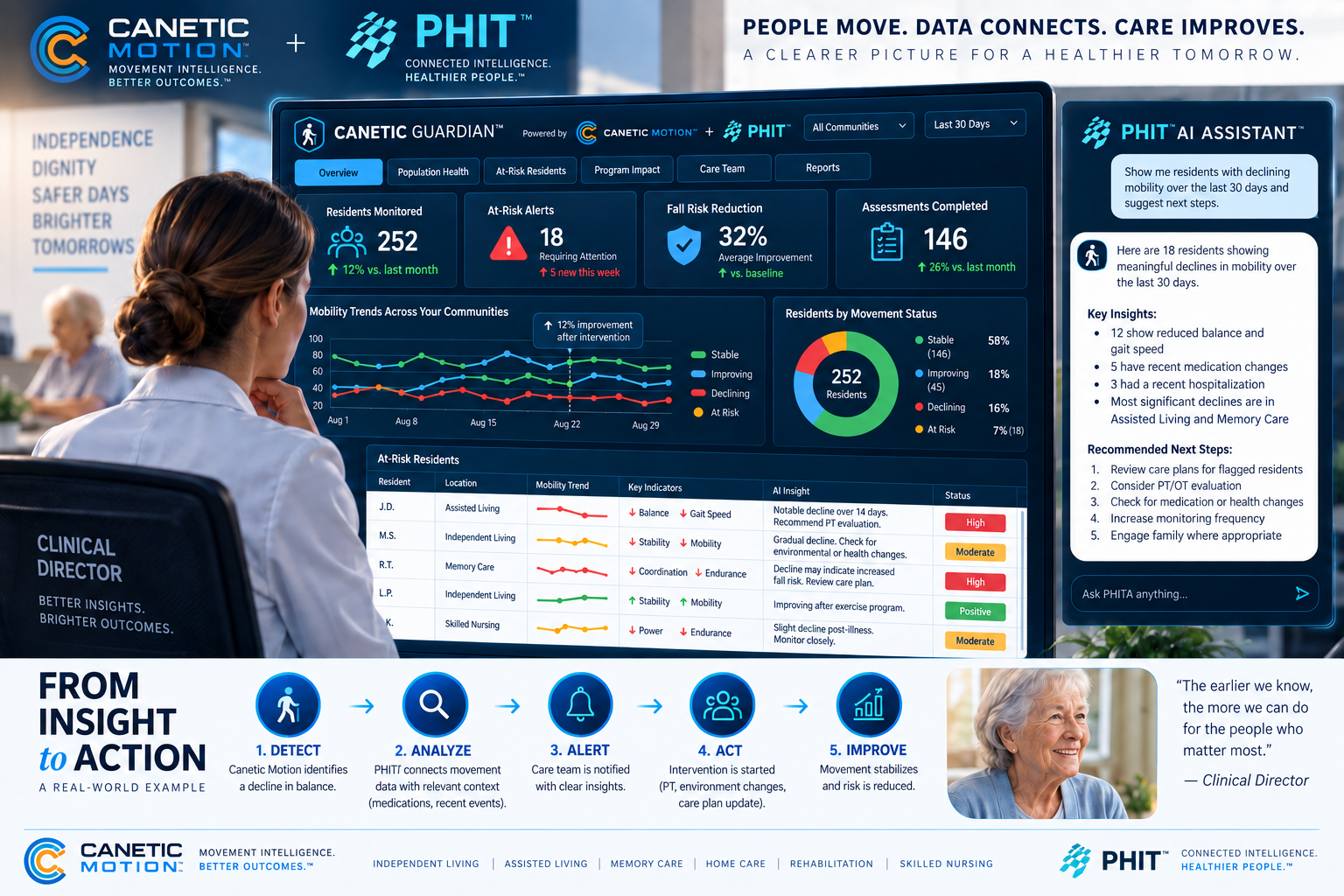
Senior care has often been forced to react after something happens. DPL creates a different rhythm: establish a repeatable movement baseline, make change visible, help the right people understand it, support appropriate action and measure again.
Senior care is not one market. The value changes depending on where the person is in the aging and care journey. We simplify that continuum into four commercial paths.
Active adult, independent living and senior wellness. Lead with healthy aging, resident engagement, measurable programming and the ability to compare a person's movement with their own prior baseline.
Lead with independence, fall-prevention support, family confidence, caregiver-facilitated movement checks and visibility into meaningful changes that may deserve review.
Home health, PT/OT and skilled nursing. Show the functional journey from admission through treatment and discharge, with repeatable movement context alongside established clinical measures.
PACE and coordinated senior networks. Create a portable longitudinal movement signal that can follow the person across home, centers, providers and transitions.
The value comes from combining movement information with the broader permitted information around the person, while keeping human judgment and intervention at the center.
Standardized capture, movement scores, trends and longitudinal movement history. The core question: what is changing in the way this person moves?
Connect permitted data sources and make relevant context accessible through role-appropriate intelligence.
Caregivers, therapists, clinicians and operators determine the appropriate response and intervention.
Better visibility into progress, independence and meaningful change without turning technology into diagnosis.
Greater visibility into movement history, progress and stability—supporting motivation, confidence and ownership.
Objective context in addition to anecdote alone, with better questions to ask caregivers and clinicians.
Structured information supporting observation, simple cues for review and a clearer handoff to appropriate professionals.
Treatment trajectory and reassessment information between formal visits without replacing clinical judgment or diagnostic tools.
Differentiation, program measurement, family engagement and a clearer view of stable, improving and changing populations.
Cross-site trends, population intelligence and a portable functional signal that can support broader value-based strategies.
“How am I moving compared with three months ago?”
“Is Mom or Dad stable, improving or meaningfully changing?”
“Who may deserve a closer look today?”
“What does the movement trajectory look like over this episode of care?”
“Where are our programs creating measurable movement outcomes?”
“What patterns are emerging across our locations and populations?”
The first senior-care pilot should be simple: one population, one clear use case and one repeatable workflow. Establish the movement profile, reassess at a practical cadence, review stable/improving/changing profiles and report what the organization learned before expanding integrations.
The proposition is stronger when its boundaries are clear. DPL and Canetic Motion should surface observable movement performance and meaningful trends for review, while clinical decisions remain with qualified professionals.
We should not claim that the system predicts a fall or diagnoses a medical condition unless separately validated and authorized for that claim. Alerts should be framed as meaningful movement change, performance trends or information for review, with consent, role-based access and appropriate privacy controls.
The result is not surveillance. It is not technology replacing care. It is better information in the hands of people trying to preserve independence.
Start with one community, one branch or one care cohort. Build a movement baseline, make meaningful change visible and show your organization where Senior Movement Intelligence can create measurable value.